

Modern Minimalism in Motion: The Appeal of Handleless Kitchens
Oakmont Kitchens & Interiors, Johannesburg
Handleless kitchen design in Johannesburg has become one of the defining expressions of warm minimalism — a design language shaped by clean lines, soft movement, and cabinetry that feels intentionally quiet.
It’s a style that does not compete for attention; instead, it settles into the architecture of the home with a sense of ease.
Globally, publications like Dwelland Dezeen continue to highlight kitchens where the absence of hardware enhances the rhythm of the space rather than limiting it.
For homeowners and architects alike, the handleless kitchen offers a balance of simplicity and refinement — a space defined not by ornamentation, but by proportion, materiality, and motion.
This minimal approach aligns seamlessly with kitchen design in Johannesburg, where modern homes favour clean façades and integrated living.
The Three Main Handleless Systems Explained
Handleless design doesn’t mean the same thing in every kitchen — there are different engineering solutions, each bringing its own architectural effect.
Understanding these systems helps designers choose the right expression for each home.
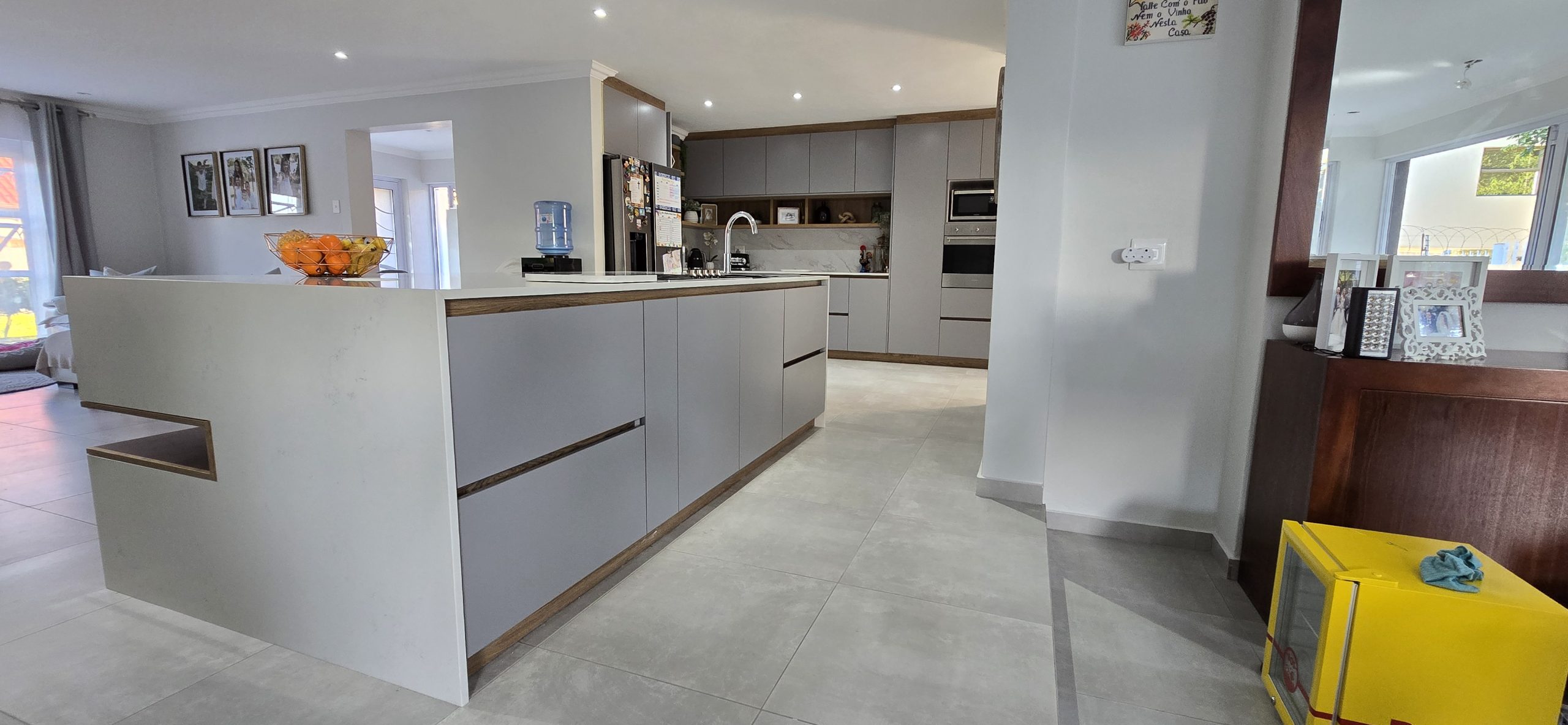
1. True Handleless with Aluminium Rails
This is the most architectural expression of the style.
Slim aluminium rails are recessed into the cabinetry, allowing fingers to pull drawers and doors from behind the façade.
Benefits include:
- ultra-clean horizontal or vertical lines
- consistent geometry across large cabinetry runs
- ideal compatibility with textured or matte doors
- no visible hardware interrupting the design
This approach works beautifully in imported premium kitchens, where accuracy in proportion and detail is essential.
2.Push-to-Open Systems
A mechanical or magnetic system that activates with gentle pressure.
Perfect for uninterrupted surfaces and clients who prefer a seamless aesthetic.
Its appeal lies in:
- absolute minimalism
- uninterrupted sightlines
- tactile interaction with the cabinetry
Soft technology from brands like Blumenables this motion with quiet precision.
3.Integrated Profile Handles
A subtle inset or routed detail that creates a shadow line.
Not technically “handleless,” but it delivers a similar clean aesthetic with improved ergonomics.
Best for:
- heavy pantry doors
- wide drawers
- households preferring enhanced grip
- kitchens with a mix of minimalism and practicality
This detail is often highlighted in kitchen cabinets across Johannesburg, where clients are drawn to minimal forms that still meet everyday function.
Why Handleless Kitchens Work So Well in Johannesburg Homes
Johannesburg’s interior design culture has shifted toward a softer kind of luxury — one that favours:
- open-plan living
- clean architectural lines
- warm, natural textures
- an emphasis on proportion, light, and flow
Handleless kitchens naturally support this shift.
A calm, unbroken visual field
Without handles interrupting the façade, the kitchen feels more like part of the architecture than an appliance collection.
Material continuity
Board manufacturers such as PG Bison and Sonae produce textured and matte finishes that look exceptional in handleless applications.
This allows designers to build kitchens that feel cohesive, quiet, and grounded.
A modern response to open-plan living
In connected spaces, any visual clutter affects the entire room.
Handleless design softens the presence of the kitchen and enhances the home’s overall calm.
How Hardware Shapes Handleless Design
Even in the absence of visible handles, hardware plays a defining role.
Soft-close runners and hinges
Quiet movement is essential — especially in minimal kitchens.
Premium systems from Blum and Grass ensure that openings feel controlled and precise.
Load-bearing accuracy
Handleless drawers rely heavily on runner strength.
This makes engineering quality more important than in traditional kitchens.
Integrated lighting compatibility
Handleless designs pair beautifully with soft perimeter lighting or internal glass-display illumination — another major trend influencing cupboard design in Johannesburg.

Common Misconceptions About Handleless Kitchens
“They’re hard to clean.”
In reality, the absence of protruding handles reduces dust-collection points.
Aluminium rails are easily wiped, and routed profiles have smooth curves for simple maintenance.
“They don’t work with textured finishes.”
Modern board technology has changed this completely.
Soft, tactile wood-grains and matte finishes look exceptional in handleless formats.
“They’re only for ultra-modern homes.”
When paired with warm tones, architectural lighting, and a grounded colour palette, handleless kitchens feel timeless — not futuristic.
Where Handleless Kitchens Make the Biggest Impact
- open-plan apartments
- contemporary family homes
- compact kitchens where handles feel visually heavy
- luxury interiors seeking calm minimalism
- imported premium kitchen installations
- spaces requiring proportional balance and simplicity
These environments benefit from a kitchen that feels more like architectural joinery and less like a traditional working space.
Final Thought
A handleless kitchen is not about removing something — it’s about revealing what matters.
Material, rhythm, proportion, light, and motion take centre stage when the design is allowed to speak without interruption.
In Johannesburg’s evolving architecture and interior design culture, this quiet minimalism offers a kind of luxury that feels both modern and enduring.