
Oakmont Kitchens & Interiors, Johannesburg
Understanding bathroom vanity cost in Johannesburg is not always as simple as comparing one unit to another.
At first glance, most vanities seem to perform the same role.
They hold a basin.
They provide storage.
They finish the bathroom.
But in a well-designed space, a vanity does more than that.
It affects proportion.
It changes how the bathroom feels.
It influences storage, movement, maintenance, and the way the room is used every day.
That is why vanity pricing can vary so widely.
Not because one option is simply expensive and another is cheap.
But because they are often not the same thing.
Quick Answer: What Does a Bathroom Vanity Cost in Johannesburg?
As a broad guide, a custom bathroom vanity in Johannesburg can range from approximately R12,000 to R45,000+, depending on size, materials, drawer systems, countertop choice, basin type, mirror integration, lighting, and installation requirements.
A simple vanity may sit toward the lower end of the range.
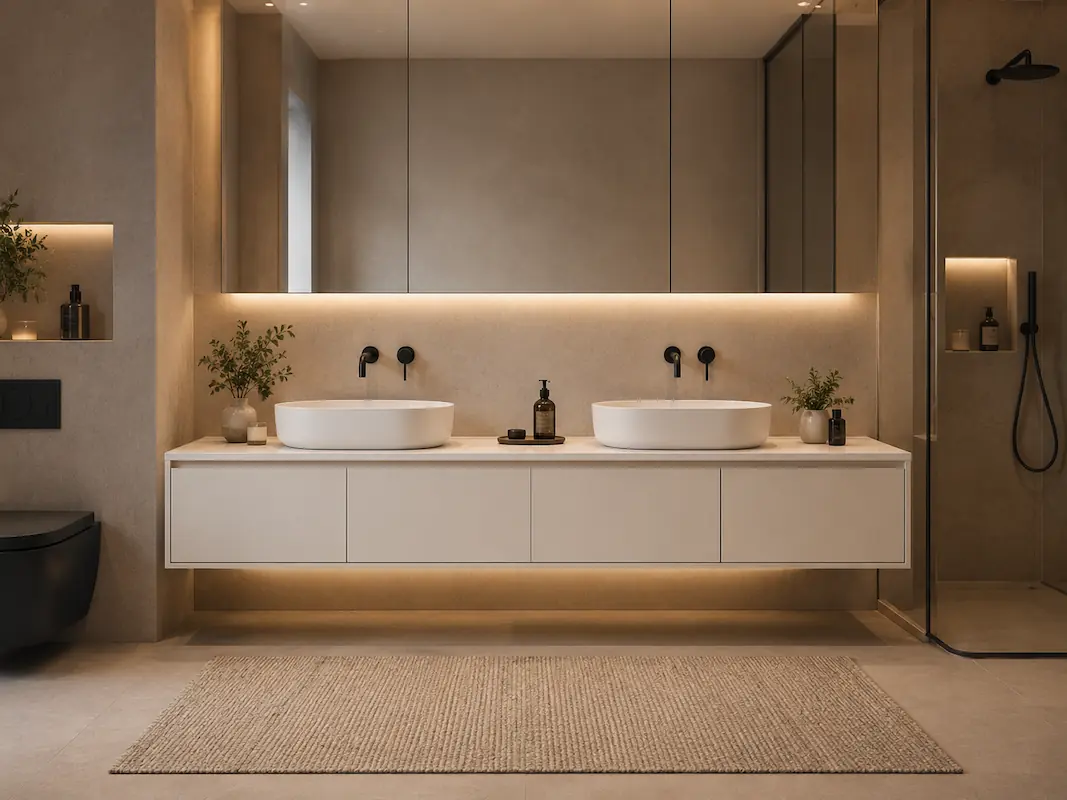
A larger, double-basin, floating vanity with premium finishes, stone tops, custom mirrors, lighting, and detailed storage will naturally sit higher.
These figures are general guidance only. Every vanity should be priced according to its final design, measurements, materials, and site requirements.
Why Vanity Pricing Varies So Much
A vanity is one of the smallest joinery elements in a home.
But that does not mean it is simple.
Bathrooms are compact spaces.
The details are close together.
Every line, shadow, joint, handle, basin, and mirror becomes visible.
There is less room to hide poor proportion.
A vanity that feels slightly too heavy can make the bathroom feel smaller.
A vanity that is too shallow may not offer enough storage.
A vanity that is too plain may disappear in a room that needs warmth or texture.
This is why cost is not only about size.
It is about how resolved the piece needs to be.
For a broader visual overview of how Oakmont approaches vanity design, explore our custom vanities page.
The Main Factors That Affect Bathroom Vanity Cost
The final cost of a bathroom vanity is usually shaped by several connected decisions.
None of them exist in isolation.
A change in material can affect the look.
A change in basin can affect the countertop.
A change in drawer layout can affect plumbing clearance.
A change in mirror size can affect lighting and proportion.
That is why the vanity should be designed as a complete element, not priced as a loose cabinet.
When choosing a kitchen company, it helps to understand whether the process is simply quote-driven or properly design-led.
A design-led process looks beyond finishes and pricing. It considers how the kitchen will move, how it will store, how it will sit within the home, and how each decision will hold up over time.
For more on this approach, explore our kitchen designers in Johannesburg page.
1. Vanity Size
Size is one of the first cost factors.
A compact guest bathroom vanity will usually require fewer materials, less hardware, and less manufacturing time than a long double vanity in a main en-suite.
But size alone does not tell the full story.
A small vanity with curved sides, premium finishes, stone cladding, and integrated lighting can cost more than a larger but simpler unit.
Still, as a general rule:
- smaller single vanities are more cost-efficient
- double vanities require more materials and hardware
- longer vanities need better support and careful proportion
- floating vanities require proper wall fixing and installation planning
The larger the vanity becomes, the more important the design becomes.
A long vanity with poor drawer spacing or awkward basin placement can feel unresolved very quickly.
2. Floating vs Floor-Mounted Vanities
Floating vanities often feel lighter and more modern.
They create visual space beneath the unit.
They make the bathroom feel more open.
They work especially well in contemporary bathrooms where clean lines and shadow gaps matter.
But floating vanities can also require more planning.
The wall needs to support the unit properly.
The fixing method must be considered.
Plumbing needs to be allowed for.
Drawer depths may need to be adjusted.
A floor-mounted vanity may be simpler from an installation point of view, but it can feel heavier if not designed carefully.
Neither option is automatically better.
The right choice depends on the bathroom.
For more on this design choice, see our guide to floating bathroom vanity ideas.
3. Material Selection
Material selection has a major influence on vanity cost.
A basic melamine vanity will usually be more affordable.
A vanity using premium board finishes, timber-look textures, sprayed finishes, wrapped details, fluting, stone cladding, or custom painted panels will sit at a higher investment level.
The material affects more than appearance.
It affects:
- durability
- cleaning
- edge detail
- moisture resistance
- visual warmth
- how the vanity sits within the bathroom
Bathrooms need materials that can cope with daily use, humidity, and cleaning.
This does not mean every vanity needs the most expensive finish.
It means the finish needs to be appropriate.
Suppliers such as PG Bison provide a wide range of board finishes used in South African cabinetry and interior joinery.
4. Countertop Choice
The top of the vanity changes the entire cost structure.
Some vanities use a manufactured board top.
Others use stone, quartz, porcelain, compact surfaces, or slab-style finishes.
A stone or quartz top will usually increase the cost because it involves:
- material cost
- fabrication
- basin cut-outs
- edge profiling
- transport
- installation
- coordination with the vanity unit
But it can also elevate the whole bathroom.
The countertop is one of the most visible surfaces in the room. It frames the basin, catches light, and sets the tone for the rest of the finishes.
For many clients, this is where the vanity shifts from functional cabinetry into a more considered design feature.
Eezi Quartz is one example of a locally available quartz surface supplier often used in South African interior projects.
5. Basin Type
Basins affect both cost and design.
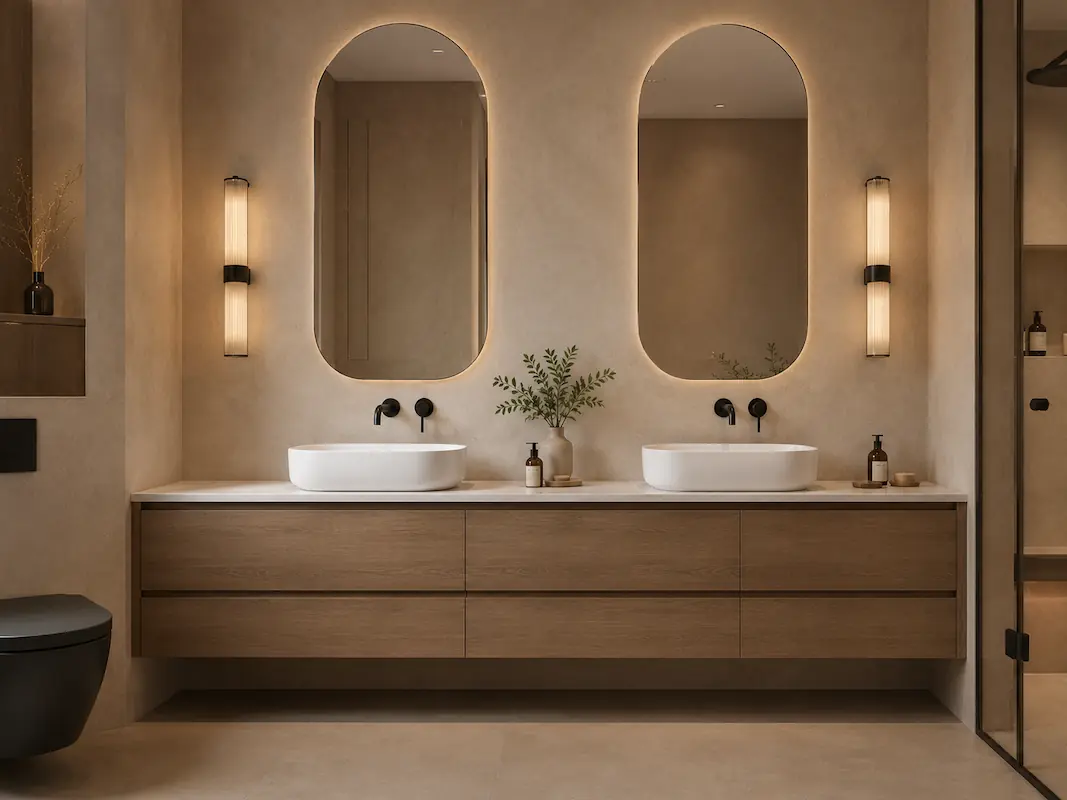
A countertop basin creates a strong visual moment.
An undermount basin feels cleaner and more integrated.
An integrated basin top can simplify the overall look.
A double-basin layout requires more planning and more space.
The basin choice affects:
- countertop cut-outs
- plumbing positions
- drawer design
- usable surface space
- cleaning
- mirror alignment
A basin should never be chosen only because it looks good in isolation.
It needs to work with the vanity.
A beautiful basin placed badly can make the whole piece feel awkward.
6. Drawer Systems and Hardware
Hardware is one of the details clients do not always notice at first.
Until they use the vanity every day.
A drawer that opens smoothly matters.
A drawer that carries weight properly matters.
A drawer that does not fight with plumbing matters.
Bathroom vanities often require more careful drawer planning than standard cabinetry because plumbing sits inside the unit.
This means drawer depths, cut-outs, and internal storage need to be designed properly.
Premium drawer systems generally cost more, but they improve the way the vanity performs.
Hardware brands such as Grass manufacture drawer and hinge systems used in cabinetry where long-term movement and durability matter.
7. Mirrors and Lighting
A vanity is rarely just the cabinet.
The mirror above it often completes the composition.
A simple mirror may be cost-effective.
A shaped mirror adds softness.
A framed mirror adds warmth.
A backlit mirror creates atmosphere.
A mirrored cabinet adds storage.
Lighting can also change how the vanity feels.
Poor lighting can make even a well-made vanity feel flat.
Good lighting can make materials feel warmer, softer, and more resolved.
This is why bathroom vanity cost often increases when the vanity is designed together with the mirror, lighting, and surrounding wall finish.
It becomes a full vanity zone.
Not just a cabinet below a basin.
8. Custom Detailing
Custom detailing is where pricing can move quickly.
This may include:
- fluted fronts
- curved ends
- shadow lines
- recessed handles
- mitred panels
- open shelving
- timber frames
- stone side cladding
- integrated LED lighting
- custom mirror frames
These details are not always necessary.
But when used properly, they can define the space.
The important question is not:
“Can we add more detail?”
It is:
“Which detail actually improves the design?”
A great vanity does not need every possible feature.
It needs the right ones.
9. Installation and Site Conditions
Installation also affects cost.
A vanity installed into a straight, prepared wall is different from one that needs to work around uneven surfaces, existing plumbing, wall tiles, structural limitations, or tight access.
Site conditions matter.
Bathrooms are often less forgiving than kitchens because the space is smaller and tolerances feel tighter.
A vanity needs to align with:
- tile lines
- wall edges
- mirrors
- plumbing points
- floor levels
- shower screens
- surrounding finishes
That level of alignment takes planning.
And planning has value.
What Is Included in a Bathroom Vanity Quote?
This depends on the supplier or company, so it should always be clarified.
A vanity quotation may include only the cabinet.
Or it may include:
- design
- manufacturing
- hardware
- countertop
- basins
- mirrors
- installation
- delivery
- lighting
- plumbing coordination
This is why comparing vanity quotes can become confusing.
One quote may look cheaper because several items are excluded.
Another may look higher because it includes more of the complete vanity zone.
Before comparing prices, compare scope.
That is where the real difference sits.
Custom Vanity vs Store-Bought Vanity
A store-bought vanity can be a practical solution for certain bathrooms.
It is usually quicker.
Often more affordable.
And sometimes perfectly suitable for a simple space.
But it comes with limitations.
The size is fixed.
The finishes are limited.
The storage may not suit the room.
The plumbing may not align perfectly.
The proportions may feel slightly off.
A custom vanity is different.
It is designed around the space.
That means the width, height, depth, finish, drawer layout, basin position, mirror relationship, and storage can all be resolved together.
This is where custom work begins to justify itself.
Not because it is more complicated.
Because it is more specific.
For clients planning a custom vanity in Johannesburg, our bathroom vanities Johannesburg page explains Oakmont’s approach to design, manufacturing, and installation.
When a Higher Vanity Cost Makes Sense
A higher vanity cost makes sense when the vanity is doing more than filling a gap.
It may make sense when:
- the bathroom is part of a premium renovation
- the vanity is a main visual feature
- storage needs to be carefully planned
- the vanity needs to match other joinery
- the bathroom has unusual dimensions
- the client wants a specific material or finish
- the mirror and lighting are part of the design
In these cases, the vanity becomes part of the room’s identity.
It is not simply a cabinet.
It is the piece that anchors the bathroom.
When to Keep the Vanity Simple
Not every bathroom needs a highly detailed vanity.
Sometimes the right move is restraint.
A guest bathroom may only need a clean floating unit.
A small en-suite may need storage without visual heaviness.
A family bathroom may need durability more than decoration.
Simple does not mean basic.
It means controlled.
A well-proportioned, well-made vanity in the right material can often do more than an overdesigned one.
The goal is not to spend more.
The goal is to spend where the result improves.
Bathroom Vanity Cost Examples
The examples below are general guidance only and should not be read as fixed pricing.
Compact Custom Vanity
A smaller single vanity with standard board finishes, basic drawers or doors, and a simple top may sit from approximately:
R12,000 – R22,000+
This type of vanity may suit guest bathrooms, smaller en-suites, or simple upgrades.
Mid-Range Custom Vanity
A larger vanity with improved finishes, drawer systems, better internal storage, and a more considered countertop may sit from approximately:
R22,000 – R38,000+
This is often where the vanity begins to feel more designed and integrated.
Premium Custom Vanity
A premium vanity with double basins, stone tops, custom mirrors, lighting, textured fronts, curved details, or integrated storage may sit from approximately:
R38,000 – R65,000+
These vanities are usually part of more considered bathroom projects where the vanity plays a major design role.
Why the Cheapest Vanity Is Not Always the Lowest Cost
A cheaper vanity may solve the immediate problem.
But if the proportions are wrong, the storage is poor, or the finish does not hold up, the saving can become frustrating over time.
Bathrooms are used daily.
That daily use exposes weak decisions quickly.
A drawer that does not work around plumbing.
A finish that feels out of place.
A basin that leaves too little counter space.
A vanity that looks too small for the wall.
These things may not be obvious in a quotation.
They become obvious in the room.
This is why proper design matters.
How to Plan Your Vanity Budget
A better way to plan the budget is to decide what role the vanity plays in the bathroom.
Ask:
Is it purely functional?
Is it the main design feature?
Does it need to provide serious storage?
Does it need to match other cabinetry in the home?
Will it include mirrors, lighting, or stone?
Is the bathroom compact or spacious?
The answers will help determine whether the vanity should be simple, mid-range, or more detailed.
Budget should follow intent.
Not the other way around.
Final Thoughts
Bathroom vanity cost in Johannesburg depends on more than the size of the cabinet.
It depends on how the vanity is designed.
How it stores.
How it sits in the room.
How it works with the basin, mirror, lighting, and surrounding finishes.
A well-designed vanity does not need to be excessive.
But it does need to be considered.
Because in a bathroom, small details are rarely small for long.